Coffee Mania - Sorting Jam
- 4.5
- Rating
- 10.00M
- Installs
- Free
- Price

 Analysis by App-foxy
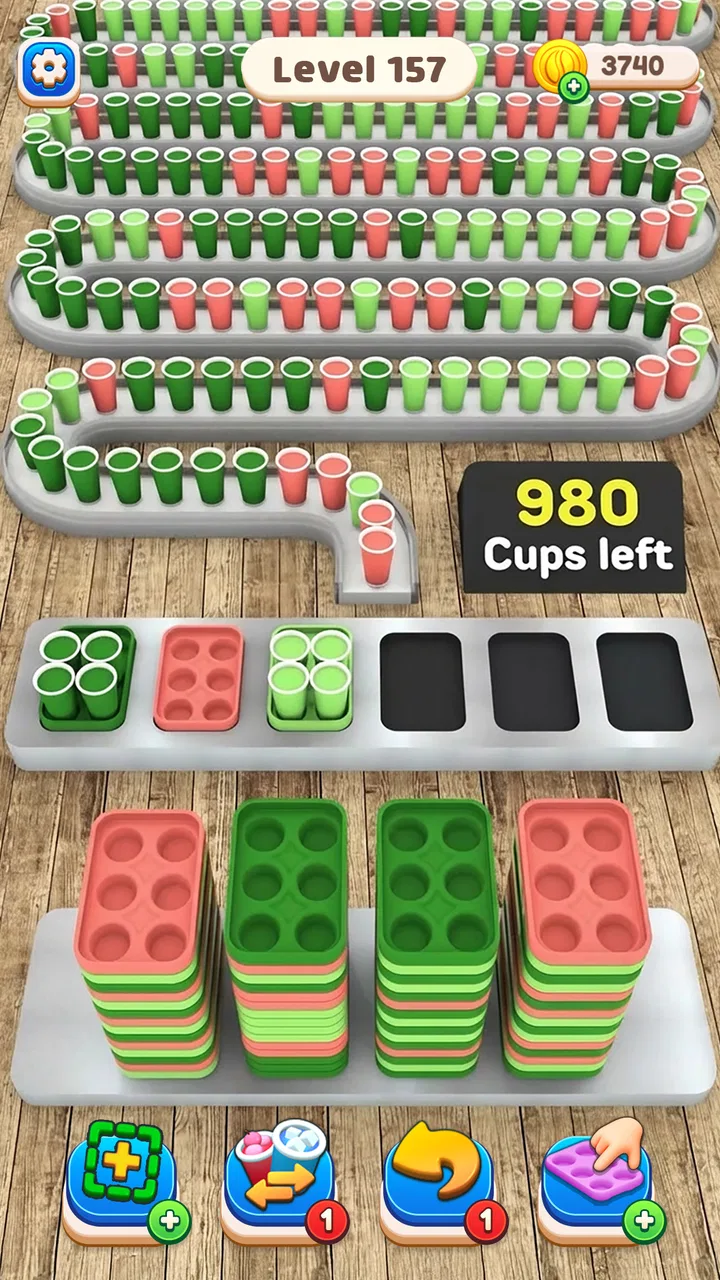
I approached Coffee Mania - Sorting Jam expecting a simple color-matching diversion, but its central idea is more interesting in practice: I have to sort coffee packs by color while dealing with blocked spaces and crowded arrangements. That single capability gives the game its identity. It is not just about spotting matching colors; it is about deciding which move will create room without turning the board into a harder mess a few seconds later.
That makes this a puzzle game for short, focused sessions rather than a story-driven experience. Developed by CrazyLabs LTD, it is free to start and has an Everyone age rating, so it is easy to recommend for casual play across a household. The game has reached over ten million installs and holds a 4.5 average from around one hundred twenty-two thousand ratings, which fits my impression: the concept is immediately understandable, but the later decisions can demand more patience than the cheerful presentation suggests.
The store’s short description calls it Coffee Mania, yet the playable idea is best understood as a color sort puzzle built around unblocking coffee packs. That distinction matters. If you want a long adventure, a narrative campaign, or a competitive multiplayer game, this is not aiming in that direction. If you want a compact visual problem that can fill a spare moment and still make you think, its focused design works well.
You May Also Like

 Blood Strike: 2.5 Anniversary
Blood Strike’s Loadouts Turn Every Drop Into a Tactical Gamble
A close look at Blood Strike’s custom loadouts: how fast access to signature weapons reshapes its battle royale rhythm, rewards preparation, and narrows the gap between fights.

 Pandora - Music & Podcasts
Pandora’s Music Is Easy to Start, but Harder to Recover
Pandora’s strength is its low-effort path from a seed to a station. Its weak spot is how much confidence it asks you to place in connection, setup, and quiet recovery.

 8 Ball Pool
 Is Built on Rivalries, Rematches, and Routine
A close look at the rivalries, rematches, shared routines, and unanswered safety questions that turn a quick pool match into a persistent mobile community.

 Samsung Music
’s Quiet Strength Is Playing What You Already Own
Its reach comes less from spectacle than from dependable access to a personal library. That simplicity is both the app’s strongest retention engine and its ceiling.

 AccuWeather: Weather Radar
AccuWeather Review: A Quick, Clear Forecast for Everyday Decisions
For everyday plans, the best forecast is the one you can understand quickly. AccuWeather makes rain timing, radar, and local conditions easy to act on, with a few trade-offs.

 Hill Climb Racing
Why Hill Climb Racing Still Turns Crashes Into One More Run
A tiny car, a bumpy hill and one more upgrade: Hill Climb Racing keeps resurfacing because its simple chaos makes every near-miss feel personal.
More From Our News Desk



Sorting is the feature that makes each move matter
The strongest part of the game is the way sorting and unblocking affect each other. A color may look ready to collect, but reaching it can require moving another pack first. That creates a small chain of consequences: I am not only asking which color belongs where, but also which piece is preventing the useful move from happening.
In easier moments, the solution feels almost automatic. I identify a color, tap through the obvious arrangement, and watch the board open up. The satisfaction comes from clearing a visual knot. In more demanding moments, the same screen becomes a planning exercise. A move that appears productive can consume the space I need for the next group, while a less obvious move can expose the path to several useful matches.
The important skill is preserving options, not simply clearing the first available color. I found that this mindset changes the experience. Players who rush toward immediate matches may occasionally create unnecessary congestion, while players who pause to inspect the whole arrangement usually make steadier progress. The game therefore rewards visual organization more than speed.
That is also why the coffee theme is more than a decorative label in my experience. The packs give the board a recognizable visual language, making the sorting task easier to read than an abstract collection of colored tiles might be. I can quickly distinguish the objects, identify the blocked area, and focus on the order of operations rather than learning an unfamiliar interface.
What a normal round feels like
I usually begin by scanning the entire board instead of tapping immediately. I look for colors that already have a clear route, then check whether moving them will open a useful space or merely shift the problem elsewhere. This brief pause is valuable because the game’s challenge comes from sequencing. The first move is often less important than what it allows me to do next.
Once I commit, the feedback is easy to follow. The visual movement of the coffee packs shows whether the board is becoming more open or more crowded. That makes mistakes understandable rather than mysterious. When I fail to solve a layout, I can usually identify the moment where I spent space too early or ignored a blocked color.
For a casual puzzle, that clarity is a real strength. I do not need to remember a complicated rule set, and I can return after a break without relearning a character roster, map, or story. The cost is that the experience depends heavily on whether you enjoy repeated visual sorting. If that basic action does not appeal to you, the theme alone will not carry the game.
A useful routine is to separate “safe” moves from “committing” moves. A safe move clears a color without closing off another route. A committing move changes the available space enough that several later actions depend on it. I try to make the safe moves first, then reconsider the board before making a commitment. This is a small habit, but it reduces the feeling that a level was lost through bad luck.
How to play more deliberately
My first practical tip is to watch empty space as carefully as the colored packs. Players naturally follow the objects, but the open areas determine whether the next group can be placed or moved. When the board is busy, I mentally mark the spaces that must remain available. That turns the puzzle from a search for matches into a search for usable routes.
My second tip is not to treat every visible match as urgent. A match can be attractive because it offers immediate progress, yet delaying it may reveal a better order. I often check whether the same color is blocking a different group before acting. If it is, clearing that obstruction may be more valuable than completing the easiest visible combination.
My third tip is to use a short reset in attention after every major clearing. Once several packs move, the board’s priorities change. Continuing with the old plan can lead to unnecessary mistakes because a previously blocked color may now be accessible. I find that a one-second scan after a large change is more useful than trying to play continuously.
These are not complicated techniques, but they explain why the game can hold attention beyond the first few rounds. The rules stay simple while the consequences become more layered. That is a good balance for a mobile puzzle, especially when I want something that is easy to start but not entirely mindless.
The best everyday use: a short break with a little focus
The ideal scenario for me is a waiting period that is long enough for concentration but too short for a large game. I can play while waiting for an appointment, during a commute when I am safely stationary, or between tasks at home. The coffee-pack format makes the objective obvious immediately, so I do not spend the first minutes reading instructions or rebuilding context.
It also works well as a mental change of pace after repetitive work. Sorting colors gives my attention a concrete target, while the short puzzle structure avoids the commitment of a lengthy session. I can stop after solving a layout without feeling that I have abandoned a campaign or left a team depending on me.
For younger players, the Everyone rating and straightforward visual goal make the game approachable. I would still guide a child around any purchase prompts and encourage them to pause rather than tap rapidly when a board becomes crowded. For adults, the same simplicity is useful when the goal is relaxation with just enough decision-making to prevent boredom.
One particularly good use is sharing the screen briefly with someone who enjoys puzzles but does not want to learn a complex game. The sorting rule can be explained in ordinary language, and the discussion naturally becomes about which color should move first. That makes it more accessible than many strategy games, although it does not replace a proper two-player experience.
Where it sits beside other puzzle choices
Compared with a traditional match-three game, this feels less dependent on creating flashy combinations and more dependent on protecting the board’s structure. A match-three player may look for the most rewarding immediate swap; here, I am more concerned with whether a move unblocks the right route. Compared with a pure sorting game, the coffee-pack jam adds more pressure because the pieces are not simply waiting in neat containers.
It is also different from word puzzles. There is no need to recall vocabulary or interpret clues, so the challenge is visual and spatial rather than linguistic. That makes it a better fit for someone who wants quick recognition and manipulation, while a word-game fan may find the repeated color logic too narrow.
Against large logic games with many rule systems, Coffee Mania is easier to enter and easier to leave. The trade-off is depth. Its appeal comes from refining the order of simple actions, not from combining numerous mechanics. If I want a rich campaign with varied objectives, another puzzle title would probably serve me better. If I want a clean sorting problem without a large learning curve, this focused approach is more convenient.
The friction I noticed during longer play
The same narrow focus that makes the game approachable can also make it repetitive. After several sessions, the pleasure depends on whether I still enjoy the act of arranging colors and opening space. Players looking for constant novelty may feel that the central interaction does not change enough, even when the layouts become more demanding.
There is also a difference between relaxing and frustrating play. When I take time to inspect the board, the game can feel calming. When I rush because I am treating it like a reflex challenge, a poor sequence can make the screen feel cramped and unforgiving. The experience rewards patience, but it does not always announce that patience is the intended advantage.
The free entry point is convenient, though in-app purchases range from ninety-nine cents to ninety-nine dollars and ninety-nine cents per item. I would keep that in mind before handing the device to a child or allowing casual spending. The game itself is easy to try without an upfront price, but the presence of optional purchases means I would review the device’s purchase controls first.
Another practical consideration is the version. The current release is 1.5.70, and the game requires Android 7.0 or later when played on Android. That makes it compatible with many older devices, but anyone using a particularly old phone or tablet should still check the system requirement before planning around it. On supported hardware, the basic concept should be comfortable for the kind of short sessions it encourages.
I would also avoid presenting this as a serious brain-training tool. It exercises attention, ordering, and visual planning in a light way, but its main purpose is entertainment. The benefit is that it can make a break feel more active than passive scrolling; the limitation is that it should not be mistaken for a structured educational program.
Who will get the most from it
I think the best audience is someone who likes tidy visual tasks, incremental progress, and puzzles that can be understood almost immediately. The game suits players who enjoy looking for the correct order rather than reacting quickly. It is especially comfortable for people who want a mobile activity that does not require sound, a long uninterrupted session, or knowledge of a fictional world.
It may also appeal to players who normally avoid puzzle games because they find them intimidating. The coffee packs and color-based objective create a gentle entry point. You can begin with the obvious arrangement, then gradually learn to protect open spaces and plan around blocked pieces. That learning curve feels more natural than being presented with several rules at once.
I would recommend skipping it if you need strong narrative motivation, competitive rankings, elaborate customization, or a wide range of puzzle types. It is not the right choice for someone who becomes bored by repeating one core action, even when the arrangement changes. A broader logic collection would offer more variety, while a match-three game may be preferable if you want faster visual rewards and more dramatic combinations.
It is also not my first choice when I want a completely passive way to unwind. The game asks me to pay attention, and that is precisely why it works. After a tiring day, I may prefer something atmospheric or story-based instead. Coffee Mania is relaxing only when I am in the mood to make small decisions and accept that a careless move can complicate the next one.
My recommendation after spending time with it
Coffee Mania - Sorting Jam is at its best when treated as a patient, space-management puzzle rather than a fast color tapper. Its verified capability is simple—sorting coffee packs to unblock the board—but the practical effect is a satisfying need to think one or two moves ahead. That gives the game more substance than its cheerful surface initially suggests.
CrazyLabs LTD has kept the entry barrier low, and the free price makes trying it straightforward. The Everyone rating broadens its appeal, while the strong average rating and large install base show that the format has found a substantial audience. I would not use those figures as a substitute for personal taste, though. The deciding question is whether you enjoy repeated visual organization with gradually more careful sequencing.
My final advice is to play slowly at first, protect open spaces, and reconsider the board after every major movement. Those habits reveal the game’s real strength and reduce the frustration caused by impulsive taps. If you want a compact puzzle for waiting rooms, short breaks, or a quick change of mental pace, I think it is worth trying. If you need deep variety or a story to pull you forward, choose a broader puzzle game instead.
FAQs for Coffee Mania - Sorting Jam
01What is Coffee Mania - Sorting Jam about?
Coffee Mania - Sorting Jam is a puzzle game that challenges players to sort various types of coffee beans into the correct jars. It combines elements of strategy and time management, offering an engaging experience for fans of both genres. The game is designed for players of all ages and provides a fun and educational way to learn about different coffee blends.
02Is Coffee Mania - Sorting Jam free to play?
Yes, Coffee Mania - Sorting Jam is free to download and play on both Android and iOS platforms. However, the game includes optional in-app purchases. These purchases can enhance the gaming experience by providing additional features or power-ups, but they are not necessary to enjoy the game fully.
03What are the system requirements for Coffee Mania - Sorting Jam?
For Android users, Coffee Mania - Sorting Jam requires Android version 5.0 and up. For iOS users, the game requires iOS 11.0 or later. The game is compatible with both smartphones and tablets, ensuring a smooth gameplay experience across various devices. It is advisable to have a stable internet connection for optimal performance.
04Does Coffee Mania - Sorting Jam offer multiplayer options?
Currently, Coffee Mania - Sorting Jam is a single-player game focused on personal skill development and puzzle-solving. However, players can connect with friends through social media to share achievements and compete for high scores on leaderboards, fostering a sense of community and friendly competition.
05Are there ads in Coffee Mania - Sorting Jam?
Yes, Coffee Mania - Sorting Jam includes advertisements. These ads help support the developers and allow the game to be offered for free. Users have the option to remove ads through a one-time in-app purchase, which can enhance the gaming experience by providing uninterrupted gameplay.
Pros
- Engaging puzzle mechanics keep you entertained.
- Visually appealing with vibrant graphics.
- Easy to learn for all age groups.
- Frequent updates with new levels.
- Low battery consumption during play.
Cons
- Limited lives can interrupt gameplay.
- Ads can be intrusive at times.
- Requires internet for certain features.
- In-app purchases can be costly.
- Some levels may feel repetitive.

Coffee Mania - Sorting Jam
Gallery